


On one particular Saturday evening in late September, I found myself at work, swiftly maneuvering through the crowds in the bustling Yellow the Cafe. Sandwiched between ringing in orders for soujek pizzas and pulling espresso shots for someone’s halva honey latte, there was a deep pit of yearning in my stomach. It wasn’t all consuming. I was still perfectly capable of using my effervescent charm and wit to upsell the red shatta hummus to my tables (in which to dip their pizza crusts). However, the knot in my chest seemed to linger past the 5:30 and 7:00 dinner rushes. After some repeated deep sighs, I told my coworker Matthew, “I think I’m gonna go to church tomorrow.” To which he responded, “Why??” Fair question. Upon meeting me, or spending 40 hours a week with me, I suppose I do not exude the energy of someone who “goes to church.” But at this point in my early adulthood quest for a purpose and a deeper understanding of life, I thought it might be wise to resort back to the thing that has bound my family together for generations—The Swedish Lutheran Church.
At this point, I had been to church in DC twice. Once in the fall of 2019 (my freshman year of college), and again last March for Palm Sunday. In my five year hiatus of worshipping in the District, I experienced many instances of metamorphoses, as one does when they exit adolescence and approach a fully formed frontal lobe. Because of this, my feelings towards organized religion, The Church, and how I interpret God have also metamorphosed from something forced upon me into something I’d like to explore on my own accord.
This brings me to Sunday, September 29th. I visited the Luther Place Memorial Church on the base of 14th street—a stretch of DC that has seen me at my best and worst of times. There couldn’t be a better place to reckon with my spirituality and the weight of human existence. The Gospel lesson this day was from Luke 12:22-31, and it read, “Therefore I tell you, do not worry about your life, what you will eat, or about your body, what you will wear. For life is more than food, and the body more than clothing. Consider the ravens: they neither sow nor reap, they have neither storehouse nor barn, and yet God feeds them. Of how much more value are you than the birds! And can any of you by worrying add a single hour to your span of life? If then you are not able to do so small a thing as that, why do you worry about the rest? Consider the lilies, how they grow: they neither toil nor spin.” This verse sent me into a tailspin of reevaluating how I want to engage with religion in my autonomous adult life, because, obviously, whether you believe in the New Testament or not, there can be some pretty relevant themes in that bad boy.
I believe myself to be a theist. I like the idea of an omnipresent thing that exercises some sort of control over the world. The idea of everything happening at random and detached from any sort of broader meaning is not a reality I’d like to live in. Do I have a solid idea of who or what God is? No, I do not. But who does? I’d like to believe that God finds amusement in meeting people where they’re at. For example, I feel God when I remember both my maternal and paternal grandparents who were steadfast fixtures in their church and community. While worshipping at Luther Place, I could hear Poppop’s voice as I sang the litany. I could see my grandma passing me a dollar to put in the offering plate. If nothing else, sitting on an uncomfortable wooden pew and listening to a bellowing pipe organ makes me feel a deep connection to my family. Additionally, I also feel God when I’m jumping around my friends’ living room, hands in the air, scream singing Glee covers and Matchbox Twenty songs in the wee hours of the morning. These are not mutually exclusive representations of the Holy Spirit in my opinion. To quote one of the greatest cinematic masterpieces of our generation, Talladega Nights: The Ballad of Ricky Bobby, Cal Naughton Jr. hits the nail on the head for me with the line: “I like to think of Jesus like with giant eagle's wings, and singin' lead vocals for Lynyrd Skynyrd with like an angel band and I'm in the front row and I'm hammered drunk!” And that is a sentiment I strongly resonate with. I mean, if God didn’t approve of me getting blasted at social functions then why would he make alcohol the physical manifestation of his blood? I believe that when I buy my friends a round (or rounds) of Malört shots, it is no different than Jesus Christ pouring wine for his disciples at The Last Supper.
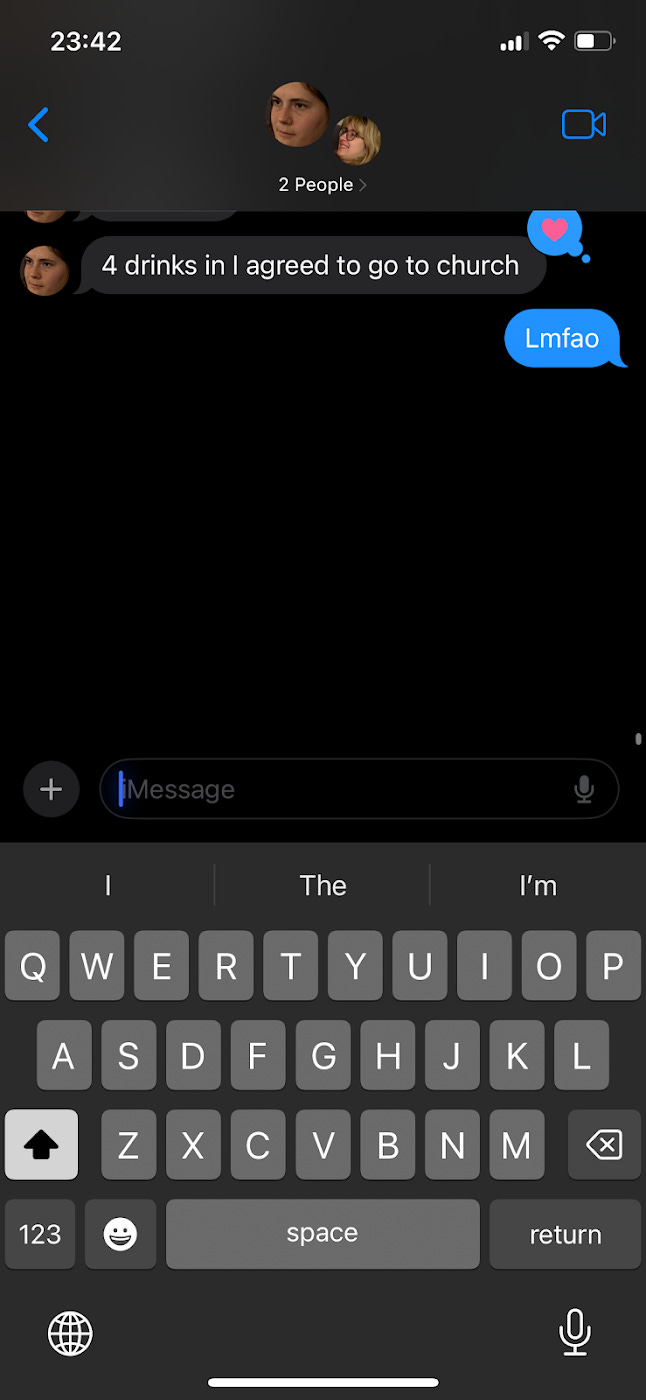
My brain is hardwired to view religion and spirituality through a traditionally Swedish Lutheran lens, being the descendent of at least four generations of Swedish Lutheran pastors. And like all good Lutherans, I was baptized in infancy, had my first communion in elementary school, was confirmed in eighth grade, and spent every single Sunday (minus the ones I spent worshipping at the altar of the Mid America Youth Basketball league) at church seated between my mom, brother, and grandpa.
I’ve always been good—no, great—at breaking bread. Whether it’s the Le Diplomate cranberry walnut sourdough or the grocery store Italian loaf my mom would buy me before every swim meet as post race refuel, communion (the breaking of bread) has played an integral part of my life both in and outside of The Church. In my childhood, the Leaflets were known to frequent a Jimmy John’s drive-thru. My go to at this point in time was the Slim #5, which (to no one’s surprise I’m sure) was just plain bread with capocollo, salami, and provolone cheese. (Telltale sign #1 that I would grow up to love and base a large part of my personality around The Sopranos.) While sitting in the backseat of my mom’s blue Kia Sedona, I would, without fail, dissect my sandwich and lay each component out on the Jimmy John’s branded paper across my lap. Then I would pinch off some bread with my right hand, place it in my left, and mutter to myself, “This is the body of Christ, broken for you.” I would take my communion, and then I’d eat the remaining cold cuts one by one. While I was blissfully unaware of my mother’s eyes on me in the rearview mirror, she watched in delight as I gave myself the sacraments in my booster seat. For those unfamiliar, Holy Communion is one of the core tenets in Lutheran theology. It is a sacred meal that spans all of time and space and allows those who commune to do so with the saints who have gone before them. A fundamental doctrine to the Evangelical Lutheran Church in America (the sect of Lutheranism in which I was raised) is that everyone is welcome at The Lord’s Table™ regardless of baptismal status, let alone religion practiced. It’s the Lord’s Table™ for heaven’s sake! Why would He turn anyone away???
Which brings me to my next point… Scooped bagels are some of the most blasphemous iterations of sacrilege on the planet. Not only are you a coward if you order your bagel scooped, you are also repeatedly stabbing God in the chest by refusing yourself the chance to break bread with your neighbor. I also believe that the concept of Pop Up Bagels was divine intervention from our Lord and Savior to get more people to partake in communion. “This (sesame bagel) is my body broken for you. Do this for the remembrance of me. This cup (of scallion cream cheese) is the new covenant in my blood, shed for you and for all people for the forgiveness of sin. Do this in remembrance of me.”
So now you might be wondering, how does all this relate to your radical politics, Maggie? Well, I’ll tell you, but you can’t blame a girl for giving some context first. It’s kinda like a chicken or the egg situation… Do my politics shape how I interpret my faith? Or does my interpretation of Lutheranism shape my politics? I think it depends on the day and how disillusioned I feel with either community. For example, when the Twitter Leftists are pissing me off with some overly convoluted discourse, I let that side take a backseat to the part of me who grew up surrounded by the calloused hand Kansas farmers who wore faded blue jeans on Sunday mornings. But most times, I believe they go hand in hand.
One of the main reasons I have resumed my spiritual journey was to contradict the notion that Protestantism is synonymous with the Religious Right. I want to make a distinction between Protestantism generally and the evangelicals, for whom I harbor the most contempt. (Please note that while I grew up in the Evangelical Lutheran Church in America, we are not affiliated with the brand of evangelicals that arose in opposition to the counterculture movement in the 60s.) ((Also please note that I intentionally used the word “brand,” as it illustrates how they’ve commodified the institution of faith.)) Evangelicals make up the congregations of those freaky megachurches that think it’s God’s will to fly a Santa Claus across the concert venues they try to pass as “sanctuaries” on Christmas Eve. Obviously, I think the way they’ve co-opted a figure who advocated for the poor, the weary, the hungry, etc. in the name of a greedy, fascist East Coast Elite business tycoon is DISGUSTING!!!!!! But I don’t want this to become an “Orange Man Bad” type piece. I’m more interested in exploring how evangelicals fully integrated conservative ideologies into their biblical interpretations and why they make it everyone’s problem. (Disclaimer: I understand that there is some irony in this analysis. Without the namesake for Lutheranism—Martin Luther—and his silly little 95 theses, Evangelicals would cease to exist, but bear with me.)

I could write a thesis on each of these observations individually, but I’m trying to be more concise in 2025. As Christianity has become inextricably linked to the conservative political ethos, these people have adopted the neoliberalism they love so much into their religious doctrine. Which is not really surprising, as capitalism itself is revered as a deity in this country. These folks claim to hate idol worship until a pastor wearing Yeezys and a Supreme hoodie starts singing “Oceans” by Hillsong. Or until an autistic billionaire scam artist illegitimate baby daddy aligns himself with the aforementioned billionaire to form a political coalition “for working class people.”
American neoliberalism is fundamentally at odds with the doctrine of religion I subscribe to. Central to neoliberalism is the whole “pull yourself up by the bootstraps” mindset. It insists upon self-efficacy and self-reliance in terms of the free market, at the expense of poor collective welfare and well-being. Similarly, there’s the evangelical notion that the self is responsible for its own salvation. A pillar of evangelicalism is conversionism, emphasizing a new or re-birth. To be a part of this particular community, YOU need to make the choice to be saved. YOU need to devote your entire life to Jesus and make loving him your whole personality in order to be accepted into heaven. Asking Jesus into your heart and being held underwater by a 30-something year old man named Brenden while wearing a Comfort Colors t-shirt that reads “I have decided” is the only path to the pearly gates, according to these people. What do you mean you’ve decided? Are you a 17-year-old high school senior who just committed to playing football at a D3 school no one’s ever heard of? They make a spectacle out of what should be a sacred and intimate testament to one’s spiritual journey. If God is the ruler of the universe, the all-knowing, all-powerful King of Kings, then why on His green Earth do you need to do this ostentatious, self-righteous song and dance? These folks seem to have forgotten the scripture from Ephesians 2:8, “For by grace you have been saved through faith. And this is not your own doing; it is the gift of God.” As a wise man and accomplished theologian (Tim Leaf) once said, “If you have to ask Jesus into your heart, you’re implying that you have the power to keep him out, and thereby believing you have power over God.”
It’s just a numbers game to these people. It’s not about the quality of the faith, it’s about the size of their congregation. It’s not about building up a resilient and tight-knit community of church-goers, but rather getting as many people as possible to play the dunk tank carnival game they call baptism on any given Sunday. They don’t care about creating lasting, sustainable change in the communities they “serve” on their mission trips (not that Western intervention is even necessary). They care about the self-satisfaction they gain from it. Like capitalism, evangelicalism is all about the bottom line.
Some of the content I’ve seen from evangelical Christian women on Instagram and Tik Tok has sent shivers coursing down my spine. Specifically, the language they use when discussing their relationship to Christ. By using phrases like “submitting myself to Him” and “giving my life to the Lord,” they weave a perverse eroticism into their faith. Why is the only way to salvation through giving up all bodily autonomy? This rhetoric reinforces the notion that subservience is the most important value in women. Also, the conflation of paternal and romantic love has become so embedded in evangelical culture, and it freaks me out. I saw one Instagram Reel where a young woman was crying in her car because she “just remembered” that her LOML (!!!) died on the cross for her sins. Girl, what? #1) How can you be in love with the single-most prevalent figure associated with fatherhood? And #2) What possessed you to work yourself up to the point of heaving sobs, press record on your iPhone, film yourself lip syncing some Lauren Daigle song, and post it on Instagram? Who was that for? It’s certainly not Our Father who Art in Heaven. I wonder what Jesus would say about these Christian influencers using his name for engagement farming. Tapping into the Creator Fund by claiming to reject all Earthly delights for Christ’s sake is hilarious actually. Speaking of influencers getting rich off of the word of God… @legitsadierob loves preaching about how believers must fear the Lord. Why! What ever happened to what a friend we have in Jesus? It must be so exhausting to walk around living in fear of the thing/figure/belief system you claim to love the most in this world.

Part of my willingness to revisit my relationship with The Big Man Upstairs is an act of resistance in itself—resistance to the notion that Christianity solely operates as an apparatus of the Right to spew hate and give themselves some “moral standing” to justify the demonization of all religious, ethnic, and socioeconomic minority groups. That is not my understanding of God. My politics and my spiritual beliefs essentially boil down to this: joy is radical and love is all there is. Practicing radical joy might be one of the most effective forms of resistance in today’s world. The system relies on your own internal misery so it can continue to exploit you, to pit you against your neighbor, to isolate you from your community. That is why I love to laugh with my friends In Spite of it All. No revolutionary ever formed an effective coalition without bringing people together through laughter. Why else do you think that Fidel Castro loved to shoot hoops with the boys? (Fact check: True). When I say love is all there is, I mean that love is the most important thing in this life. Bar none. It is the only true renewable resource, and there is not one person on Earth who is not better off because they’ve been loved.
Along adjacent lines to joy and love, if I may briefly recall the whole “Fear of God” thing… While it may be seen as noble to be a “God fearing man,” I don’t believe in living in fear. It’s a waste of time and energy, and if the Lord IS my shepherd, then why should I be afraid?
To round out the TLDR on my evolving belief system: Martin Luther was cooking in the Large Catechism when he said, “For just as we sin greatly against God every day and yet he forgives it all through grace.” On a systematic level, it’s possible, and necessary for collective liberation, to practice forgiveness through a restorative justice framework. We should give grace to our neighbors, to those who may have sinned against us, because in the eyes of Luther, the Lord offers us that same courtesy.
I really deeply believe in how the church acts as a pillar for the community, whether it’s in rural Kansas or the District of Columbia. Growing up in the church, I like to say that I had third, fourth, and fifth sets of grandparents. These people had season tickets to watch high school girls basketball every Friday night, and without fail, they’d approach me two days later on Sunday morning to tell me how much they loved watching me play. Where else does that happen? To have a space and place where people can join together out of love for their community and one another is an incredibly special thing. And it’s not all that difficult to extend this philosophy outside the church. Since considering the lilies, I have resolved to take these words of Mr. Luther’s to heart: “God doesn’t need your good works, but your neighbor does.”
Tagging myself as overly convoluted discourse